
How SCOTUS Just Blew Up IEEPA Tariffs – And What CFOs Must Consider to Get Their Money Back

The Supreme Court has just invalidated Donald Trump’s use of emergency powers to impose “reciprocal” tariffs under the International Emergency Economic Powers Act (IEEPA), but while duties stop accruing from February 24, your prior payments will not come back automatically. You will only recover cash if you treat this as a structured, multi‑year refund program across customs, legal, and tax.
What SCOTUS actually decided on IEEPA
SCOTUS did not strike down tariffs as a policy tool; it ruled that IEEPA is not a valid legal basis to impose the “reciprocal” and related emergency tariffs the Trump administration had layered on top of existing trade measures. The IEEPA is a U.S. federal law enacted in 1977 that allows the president to regulate international economic transactions after declaring a national emergency in response to an “unusual and extraordinary threat” originating outside the United States. In the consolidated Learning Resources, Inc. v. Trump and Trump v. V.O.S. Selections cases, the Court held, in a 6–3 decision, that this statute does not authorize the president to levy import tariffs and that the IEEPA-based duties therefore exceeded delegated congressional authority. Practically, this means CBP has been instructed to terminate the collection of the additional IEEPA ad valorem duties on imports, including the “reciprocal” tariffs announced on “liberation day,” with effect from February 24.
Crucially, other elements of the Trump administration’s trade toolkit remain untouched by this ruling, including the suspension of de minimis treatment (duty‑free treatment for low‑value shipments) and measures grounded in other statutory authorities.1 For finance and supply chain leaders, this split outcome creates a new workstream around maximising refunds on historical IEEPA payments while continuing to budget for all the other tariff programmes that are still very much alive.
The new (temporary) 15% global tariff baseline
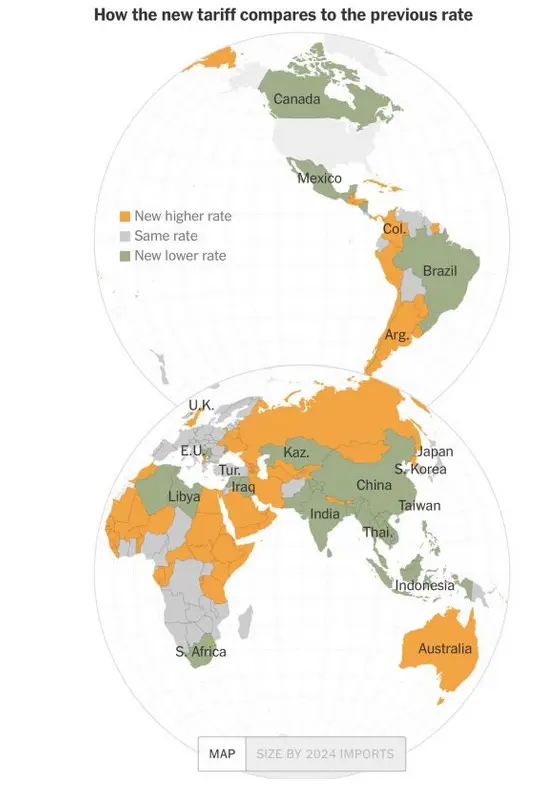
Within hours of the SCOTUS decision, President Trump pivoted to a different statute and announced a global tariff under Section 122 of the Trade Act of 1974, initially set at 10% and rapidly increased to the 15% statutory ceiling. Section 122, a rarely used provision, allows the president to impose a temporary import surcharge of up to 15% without lengthy investigations when the United States faces a “large and serious balance‑of‑payments deficit.” This move shows the administration’s ability to substitute legal instruments quickly to preserve its tariff stance, even when one tool (IEEPA) is taken off the table by the courts.
For import‑heavy retail and e‑commerce brands, this new 15% global tariff baseline creates a more uniform but generally higher tariff floor, particularly painful for countries that had previously negotiated lower rates via trade agreements or targeted exemptions. The uniform surcharge compresses the benefit of preferential rates across suppliers and geographies, reallocating the optimisation focus away from chasing marginal MFN or FTA savings and toward structural levers like tariff engineering, supply‑chain redesign, and systematic recovery of every dollar of eligible duty — including the newly refundable IEEPA amounts.
Refunds are not automatic: the three procedural channels
From a cash perspective, the key message is simple: IEEPA refunds will only flow to importers that file and defend their claims. The practical recovery channels break down along the lifecycle of your customs entries:
-
1. Open, unliquidated entries – Post‑Summary Corrections (PSCs). For entries that are still open, your fastest recovery path is to remove the IEEPA duty via PSCs and allow CBP to reliquidate the entries without the unlawful surcharge. Because these entries have not yet finalised, corrections can be processed relatively quickly, turning IEEPA from a future P&L hit into avoided cost and immediate cash preservation. 2
-
2. Recently liquidated entries – Protests within the statutory window. For entries that have already liquidated but remain within the protest period, the remedy is to file timely protests contesting the IEEPA component while preserving rights on all affected lines. CBP is likely to hold many of these protests in suspense while headquarters issues uniform guidance, so your objective is not instant recovery but locking in your position and protecting the statute of limitations across your portfolio.
-
3. Older, closed entries – Litigation and test cases at the CIT. The real money for larger importers is usually in the closed‑entry population, where the only practical route is litigation in the Court of International Trade using carefully selected test cases. This is inherently a multi‑year, litigation‑driven process, so planning should assume staged recoveries over several years, with finance, tax, and accounting teams preparing for periodic infusions of both principal and interest.
Across all three channels, the principle is the same: no filings, no refunds. For CFOs and controllers, that means treating IEEPA recovery as a structured program with defined timelines, owners, and KPIs, not as an opportunistic one‑off claim that can be handled ad hoc.
Data and documentation: why clean records will decide who gets paid
Eligibility for IEEPA refunds will ultimately rise or fall on the strength of your data and documentation, not on abstract legal theories. To substantiate claims, you will need to map IEEPA duty payments at a line‑level to specific entry numbers, demonstrate precisely what was paid and when, and show that there is no double‑dipping with other recovery mechanisms such as duty drawback, transfer pricing true‑ups, or post‑importation adjustments. Customs will not relax its evidentiary standards simply because the underlying tariff authority was struck down; if anything, scrutiny is likely to increase as aggregate refund exposure becomes clear.
For large importers, the interest component alone can become material, which makes data quality a genuine financial control issue rather than a back‑office compliance concern. This is the moment to stress‑test whether your current broker feeds, internal customs database, and ERP configuration can actually produce a reconciled view of IEEPA payments by SKU, supplier, entry date, and jurisdiction. Getting that “entry universe” under control is not just a customs task; it is a prerequisite for accurate cash‑flow forecasting, provisioning, and audit‑ready documentation when refund cheques and interest statements begin to arrive.
Tax and financial reporting: treating refunds as prior‑period recoveries
IEEPA refunds are not just a welcome cash injection; they are prior‑period cost recoveries with direct tax and financial‑statement implications. How the refunds flow through your P&L and tax returns depends on how the underlying duties were originally treated:
- If duties were capitalised into inventory, the unwind will typically run through cost of goods sold when the refund is recognised, affecting gross margin metrics, segment profitability, and potentially bonus or covenant calculations.
- If duties were expensed as incurred, you may face income pick‑up in the year the refund is received, with knock‑on effects for estimated payments and effective tax rates.
In both cases, you may need to consider amended returns or disclosures if the amounts are material and the timing of recognition crosses reporting periods. State tax, transfer pricing, and financial‑statement presentation all sit in the shadow of this customs event, which is why your tax department needs to be in the room from day one alongside customs and legal. For CFOs, the governance question is whether IEEPA recoveries are being managed as part of an integrated customs‑tax‑finance project with a clear accounting policy, or as a series of isolated transactions pushed through under time pressure.
A practical action plan for CFOs and supply chain leaders
The opportunity is significant, but so is the execution risk. A practical, board‑ready plan should cover at least the following steps:
- Quantify exposure and opportunity. Build a holistic “entry universe” that isolates IEEPA‑affected entries by status (open, liquidated within protest period, closed) and estimates both refundable duty and potential interest by year. This gives you a baseline to prioritise PSCs, protests, and litigation, and to size the upside for budgeting and guidance.
- Lock in procedural rights. Move quickly on PSCs for open entries and file protective protests for all liquidated entries still in‑time, even if CBP guidance is still evolving. For the closed‑entry population, work with counsel to identify candidate test cases for the Court of International Trade that are representative, well‑documented, and aligned with your broader litigation strategy.
- Harden your data and controls. Invest in cleaning and reconciling customs, broker, and ERP data so that every claimed refund dollar can be tied back to specific entries and payments, with clear evidence that there is no overlap with drawback or other recovery mechanisms. Treat this as a controls uplift project that will also strengthen your position on future tariff changes, Section 122 surcharges, and any subsequent policy shifts.
- Align customs, tax, and finance. Create a cross‑functional working group that owns the IEEPA recovery program, including accounting policy for refund recognition, modelling of P\&L and cash‑flow impacts, and communication with auditors and tax authorities. Ensure that interest income, balance‑sheet presentation, and any book‑to‑tax adjustments are planned rather than reactive.
- Re‑optimise your tariff strategy under Section 122. While you pursue IEEPA refunds, recalibrate your sourcing, pricing, and margin planning around the new 15% global tariff baseline under Section 122. This means reassessing landed‑cost models by product and lane, revisiting tariff engineering and restructuring options, and ensuring that every remaining dollar of duty is either strategically justified or actively targeted for reduction or recovery.
In this environment, the companies that treat IEEPA not as a legal headline but as an operational and financial workflow, grounded in data, procedure, and cross‑functional governance will be the ones that actually recover their money and report it correctly, while staying ahead of the next round of tariff policy shifts.
Trade Duty Refund specializes in customs duty reclamation for international e-commerce and import/export businesses. We will support filling for IEEPA reclaim. Contact our team to discuss your specific situation.
-
See our previous post How the Trump Administration is Using U.S. Trade Laws to Impose Tariffs: Section 301, Section 232, and IEEPA Explained ↩
-
Trade Duty Refund can help! Through our ecosystem of US brokers, TDR will find the best suited, most economical and fatest way to recover your money. Let’s talk! ↩