
Ask the Experts: How EU's 2026 Customs Changes Impact Importers by Jocelyn Montpert

Today we’re diving into a significant regulatory shifts in international trade: the announced changes to the EU Customs regulation in 2026. Whether you’re headquartered in the US, UK, China, India, Australia, or anywhere else in the world, if you’re importing goods into the European Union, these changes will directly impact your supply chain finances and duty obligations. Understanding what’s coming and preparing now could mean substantial savings and operational efficiency gains for your business. Our CEO Jocelyn Montpert shares his insights.
So today, we’re talking about the EU Customs regulation changes, known as the EU Customs Reform. This project was initiated several years ago. Why is it critical to discuss it now?
Excellent question. Indeed, the EU customs reform isn’t brand new. On May 17, 2023, the European Commission presented its proposal to reform the Union Customs Code in response to evolving geopolitical dynamics and significant challenges, particularly the exponential growth in e-commerce. The overarching goals are to digitalize, simplify, and reduce the costs associated with customs processes. The European Parliament adopted its report in March 2024, signaling serious momentum behind these changes.
What makes this critical to discuss today is a major timing shift. Initially, EU importers, especially e-commerce businesses, were bracing for significant changes by 2028. However, European Commissioner Šefčovič recently announced a considerable acceleration: 2026 is now the new deadline for suspending de minimis. This acceleration means businesses have less time to prepare, making strategic planning essential today.
De minimis? That sounds a bit familiar. Is it similar to the suspension of the US de minimis? And by the way, what exactly is de minimis?
Yes, there are similarities with the US de minimis suspension. De minimis is a fundamental customs concept describing the value threshold under which countries typically accept orders duty-free. The term itself originates from the Latin expression “de minimis non curat lex,” which literally translates to “the law is not concerned with trivial matters.”
Historically, this threshold provided relief for low-value shipments. For instance, many countries set de minimis thresholds around €150 or specific currency equivalents. The idea was that the administrative cost of processing customs duties for tiny shipments exceeded the value of the goods themselves, making duty collection economically inefficient.
However, the landscape has changed dramatically with the rise of e-commerce and direct-to-consumer shipping from non-EU sellers, particularly from major Chinese platforms. What governments initially viewed as “trivial matters” now collectively represents enormous volumes and lost duty revenue. This is why de minimis suspension is becoming a priority globally, from the US to the EU and beyond. The illustration below shows how many countries still apply some sort of de minimis on their import goods.
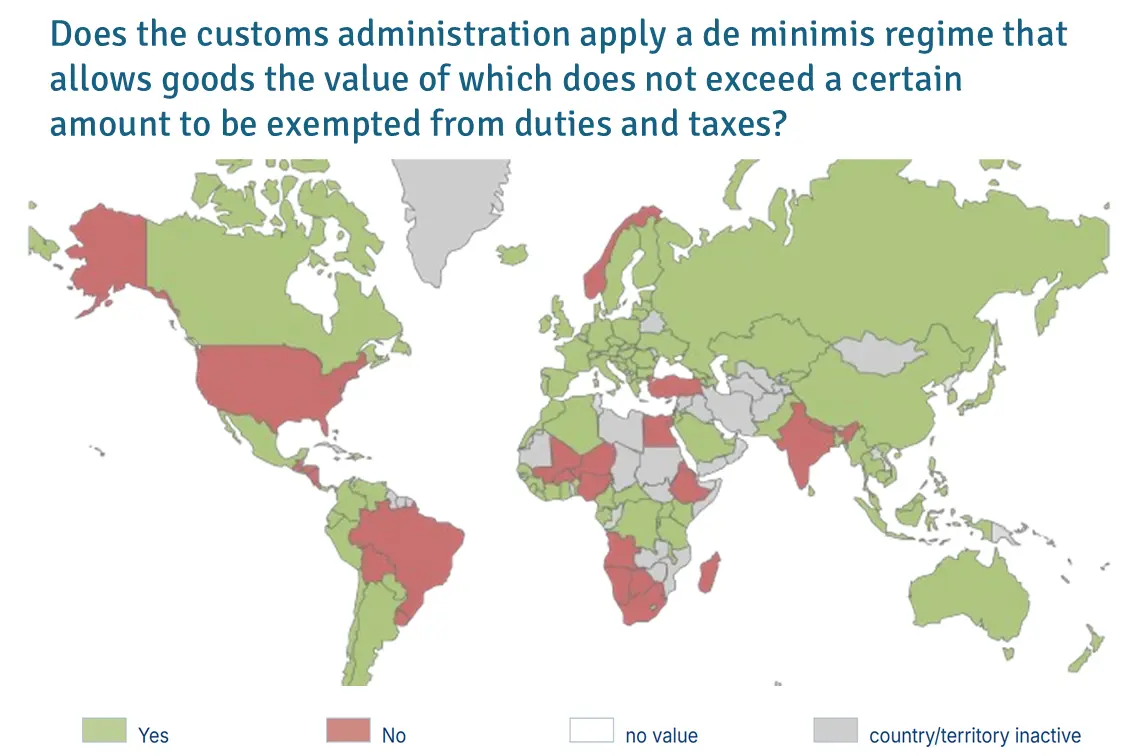 The State of de minimis in the world. Courtesy of the Global Express Association
What exactly do we know about the changes expected in 2026? What importers to the European Union should be aware of?
There are two primary changes coming in 2026 that will reshape import operations:
The €2 Handling Fee
The EU Commission has proposed a €2 administrative handling fee for parcels shipped directly to consumers from non-EU countries. If your parcel is routed through an EU warehouse first (meaning it’s already been cleared through customs), a reduced fee of approximately €0.50 may apply.
Why the handling fee? It’s designed to recover part of the costs that customs authorities bear when processing, checking, and clearing the massive volume of low-value imports flooding into the EU. Beyond cost recovery, the fee serves broader strategic objectives:
- Improved Product Safety and Conformity: Many low-value goods currently arrive without comprehensive checks against EU standards for safety and compliance. The handling fee creates an incentive structure encouraging better compliance.
- Level Playing Field: EU-based sellers and marketplaces have long complained that cheap non-EU goods (often from major Chinese platforms) enjoy regulatory and customs-light treatment. The fee aims to address this competitive imbalance.
Important: While the handling fee is technically part of the broader 2028 Customs Reforms package (which also includes creating a single EU customs authority, establishing a Customs Data Hub, and removing the €150 threshold), several EU member states are already signaling they’ll implement national handling charges ahead of the EU-wide regime:
- Netherlands: The Dutch Customs Administration is reportedly considering a €2 per product/declaration line fee on parcels entering via the Netherlands. This is partly strategic as the Netherlands serves as a major parcel portal for Europe, and unilateral fees risk diverting traffic to neighboring states.
- Romania: Bucharest has proposed a flat 25 lei fee (~€5) on non-EU parcels below €150, with an anticipated start date of November 1st, 2025.
- France: The 2026 Finance Bill includes a proposed €2 customs administration fee. France actively pushed for an early national handling fee ahead of the EU-wide implementation.
- Poland: The government is taking a more cautious approach. The deputy digital minister stated that Warsaw is exploring national solutions while keeping in mind that “only EU solutions will be fully effective.”
The bottom line: While EU-wide rollout may take time, national surcharges are already on the table, and some could begin within months.
The Suspension of De Minimis
With de minimis suspension, prepare for two major impacts:
Increased Administrative Burden: Every single order will now require a formal customs entry. This isn’t a minor procedural change: it means dramatically increased workload for customs brokers and customs authorities. We’ve witnessed this bottleneck phenomenon before, following Brexit and after the suspension of the US de minimis. In 2024, there were to 12 million low-value items(items under €150) imported every day into the EU in 2024.Expect potential increases in broker charges and a real risk of congestion at EU import points.
Mandatory Duty Payment: Except for shipments covered by special treatments like Free Trade Agreements, every order will now trigger duty payment obligations.
How will these regulatory updates impact duty payment processes and opportunities for import duty savings for companies headquartered in the US, UK, China, and other major trading countries?
Here’s the reality: duty management is becoming a critical component of supply chain finance, not just a compliance checkbox. The good news? There are smart strategies to manage your duty obligations skillfully:
Leverage Free Trade Agreements: The EU maintains an extensive portfolio of Free Trade Agreements with countries worldwide. Taking full advantage of FTA preferential rates can dramatically reduce your effective duty burden. The European Commission maintains a comprehensive list of FTAs at: https://policy.trade.ec.europa.eu/eu-trade-relationships-country-and-region/negotiations-and-agreements_en
Optimize Your Warehouse Strategy: Consider using a 3PL provider that operates bonded warehouses. For instance, many importers haven’t duplicated inventory between the EU and UK and maintain only a single location. This often means goods cross borders multiple times, triggering duty payments at each crossing. A bonded warehouse structure ensures you don’t pay import duties on goods that are simply in transit.
Consolidate Your Shipments: Bundle goods into larger consolidated shipments to mitigate the handling fee impact. Work with consolidation and deconsolidation solutions through crossdock providers. Fewer, larger shipments mean fewer handling fees, and the per-unit cost becomes minimal.
Preparing Today for Tomorrow’s Compliance
What steps can international importers take now to prepare for a smooth transition to the new EU Customs procedures?
Don’t wait until 2026 arrives. Strategic preparation starting now positions you for success:
Validate Your Product Classification: This is foundational. Audit your product descriptions and ensure your European HS codes are accurate and optimized. Incorrect classifications can trigger penalties and delays. It’s also an opportunity to identify potential tariff optimization opportunities before the regulatory environment tightens.
Prepare for Rising Brokerage Costs: Proactively discuss clearance charges with your customs broker and negotiate rates before demand spikes. Brokers will be overwhelmed in 2026, and early negotiations give you leverage today. Lock in reasonable terms now rather than accepting crisis pricing later.
Establish or Optimize Your Customs Deferment Account: If you have a registered entity in the EU, open a deferment account with customs immediately. Deferment allows you to pay customs duties later (typically monthly) rather than at each import. This improves cash flow considerably. If you don’t currently have an EU entity, 2026 changes make this a strategic investment to evaluate seriously.
Implement a Duty Drawback Solution: If you regularly return unused goods, ensure you have a robust duty drawback process in place. Duty drawback allows you to recover duties paid on goods that are subsequently exported or destroyed. With every shipment now triggering duty payments, a streamlined drawback process becomes essential for protecting your margins on returns.
Conclusion: The Time for Action is Now
The EU Customs Reform and its expected 2026 implementations represent a fundamental shift in how the EU processes imports and collects duties. While change always presents challenges, it also creates opportunities for businesses that prepare strategically. Whether you’re located in the US, UK, China, India, Australia, or anywhere else globally, understanding these changes and implementing these optimization strategies now will position your business to navigate 2026 with confidence and protect your profitability.
The key takeaway? Duty management is no longer a back-office function: it’s a strategic business imperative. Start preparing today, and you’ll thrive when 2026 arrives.
If your are or will be importing into the EU, now is the time to plan. Contact Trade Duty Refund to discuss how to prepare your business for the changes and mitigate the impact of de minimis suspension.